Human oversight is not a policy. It's a design problem.
By Joe Zhou ·
"Human in the loop" has become the default answer to every hard question about AI safety and governance. Ask a regulator how they'll manage agentic systems and they'll tell you about human oversight. Ask an auditor how they'll verify an AI management system and they'll look for human oversight. Ask a CISO how they'll get comfortable deploying an AI agent in production and they'll ask where the human sits.
The problem is that most human oversight in AI systems today is theatre. A reviewer clicks approve on an output they don't fully understand. A compliance officer signs off on a model card written by the model they're supposedly supervising. A dashboard shows green across the board and nobody looks closely until something breaks. The human is technically in the loop. The oversight is technically happening. The regulation is technically satisfied. And yet the actual safety value of the arrangement is close to zero.
Regulators are starting to notice. The EU AI Act requires that high-risk AI systems be designed so that humans can "effectively oversee" them during the period they are in use, and the operative word is effectively. ISO/IEC 42001 expects organisations to define, document, and demonstrate human oversight as part of their AI management system. Neither framework tells you how to design oversight that actually works. They tell you it has to exist and they leave the implementation to you.
That is the gap this post is about. Human oversight is not a policy problem. It is an engineering and design problem. The difference between oversight that works and oversight that doesn't is almost entirely a function of how you design the placement, the timing, the information flow, and the intervention surface. Same regulation, same staffing, same good intentions, radically different outcomes.
Why most human oversight fails
Before we get to patterns that work, it's worth naming why the default approach breaks. Most organisations implement human oversight as a final-stage approval gate: the agent or model produces an output, a human reviews it, the human clicks approve or reject. This looks sensible on a compliance diagram but it fails for four predictable reasons.
The first failure is volume. If the agent produces a hundred decisions a day and the human has ten minutes per decision, the human will either rubber-stamp or become the bottleneck. Both outcomes destroy the point of deploying the agent in the first place, and in practice the rubber-stamp is what happens because the business pressure to keep the agent running is stronger than the oversight pressure.
The second failure is information asymmetry. The human reviewing the output often has less context than the system that produced it. The agent has seen the full prompt, the retrieved context, the tool call results, and the internal reasoning. The human sees a summary. Meaningful oversight requires the reviewer to have at least enough context to detect a bad decision, and most review interfaces do not provide it.
The third failure is reversibility. A human approval gate only matters if the human can actually stop the action before it has consequences. If the agent has already sent the email, updated the record, or triggered the downstream workflow by the time the reviewer sees it, the oversight is performative. This is especially common in systems where the "review" is really a read-only audit log.
The fourth failure is accountability diffusion. When oversight is everyone's job, it becomes no one's job. Organisations that assign human oversight as a shared responsibility across a team almost always end up with gaps, because no individual feels personally accountable for any specific decision. The regulator asks "who approved this" and the answer is "the system did, and someone reviewed it."
If you recognise any of these failure modes in your current setup, you are not alone. Most AI deployments have at least two of them. The good news is that the failures are addressable once you stop treating oversight as a policy and start treating it as a design pattern.
Five patterns that work
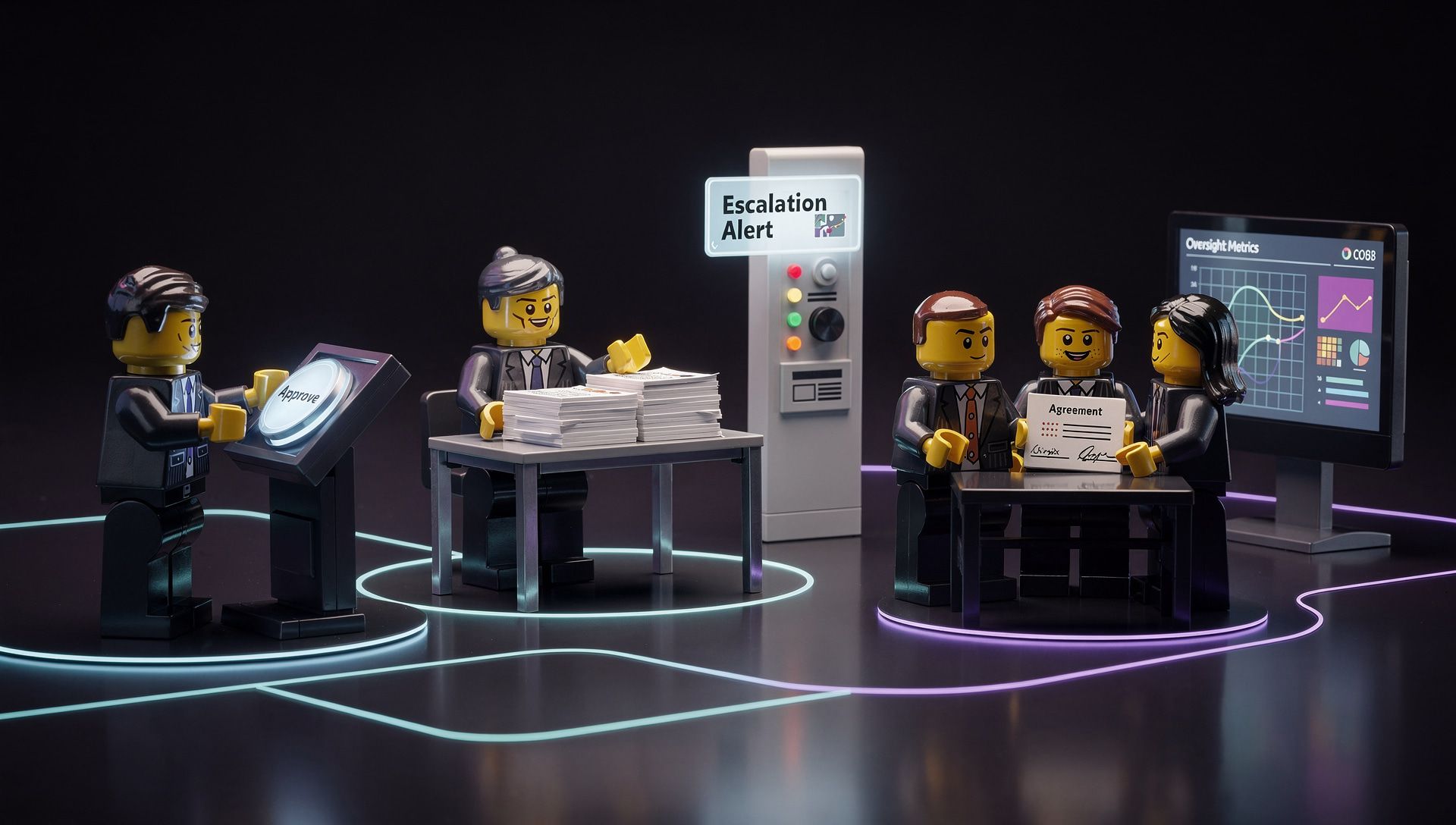
Here are five oversight patterns that hold up in practice. They are not mutually exclusive and most real systems use two or three in combination depending on what the agent is doing.
Pre-commit review. The agent prepares an action but cannot execute it until a human approves. This is the strongest pattern and also the most expensive, which is why it is the right choice for high-stakes decisions with low volume. Use it for irreversible actions, regulated decisions, customer-facing communications, and anything where the cost of a mistake is higher than the cost of a delay. The design discipline that makes this pattern work is information completeness at the decision point: the reviewer must see enough context to actually evaluate the action, not just the action itself. A pre-commit review interface that shows only the final output is pre-commit theatre.
Post-hoc audit with sampling. The agent acts autonomously and a human reviews a sample of decisions after the fact, looking for errors, drift, and emerging patterns. This is the right choice for high-volume, low-stakes work where pre-commit review would create an unmanageable queue. The sample can be random, stratified by risk, or driven by model confidence scores. The discipline here is that the sample must be large enough to surface real issues and the reviewer must have authority to trigger corrective action when they find them. Without that authority the pattern degrades into a logging exercise.
Escalation triggers. The agent handles most cases autonomously but escalates specific situations to a human based on pre-defined rules. Triggers can include low model confidence, regulatory classification of the input, monetary thresholds, customer category, novelty compared to training distribution, or any signal that the current decision is outside the agent's safe operating envelope. This pattern is powerful because it concentrates human attention on exactly the decisions that benefit from it, but it depends entirely on the quality of the trigger rules. Poorly calibrated triggers either escalate too little (and the human is cut out of the cases that matter) or too much (and the pattern collapses into pre-commit review).
Dual-control decisions. Two humans must independently agree before an action proceeds. This is the pattern banking uses for high-value transfers and the pattern regulators are starting to expect for high-risk AI decisions. It is expensive and slow, which is why it is reserved for the most consequential actions: deploying a new model version to production, overriding a safety classifier, approving a compliance exception, releasing funds above a threshold. The design question is who the second human is and whether they have genuine independence from the first. Two reviewers from the same team with the same incentives is not dual control, it is single control with a witness.
Observational oversight. A human monitors patterns in the system's behaviour over time rather than individual decisions. This is the right pattern for continuous systems where individual decisions are too frequent or too context-free to review meaningfully, but where emergent patterns can be evaluated by a thoughtful observer. Think of it as the difference between reading every email a team sends and noticing that the team has started using a new phrase. Observational oversight catches things that decision-level review misses, but it cannot catch a single catastrophic decision in real time. Use it alongside one of the other patterns, not instead of them.
How to choose
The right pattern for any specific decision depends on three variables: the stakes of a wrong decision, the volume of decisions, and the reversibility of the action. High stakes, low volume, irreversible actions need pre-commit review or dual control. Low stakes, high volume, reversible actions can use post-hoc audit. Mixed cases benefit from escalation triggers that route different decisions to different patterns within the same system.
The mistake most organisations make is choosing one pattern and applying it to everything the agent does. This is how you end up with a pre-commit review queue that is either ignored or overwhelmed, or a post-hoc audit that catches problems three weeks after they mattered. A well-designed agent system has different oversight patterns for different decision classes, routed by explicit rules rather than assumed uniformity.
How we think about it at Complyd
At Complyd, human oversight is not a layer we add on top of compliance work. It is the design principle that shapes how the work is structured from the beginning. When we design a compliance workflow, we ask four questions up front: What is the stakes profile of each decision class? What information does the reviewer need at the point of decision to evaluate it meaningfully? Where is the action reversible and where is it not? Who is personally accountable for each oversight decision, and does that person have the authority to stop the action?
Those four questions do more work than any oversight policy document we have ever seen. They force the design of the system to surface the decisions that matter, present the reviewer with enough context to act, preserve reversibility where it exists, and assign accountability to a specific human who has both the information and the authority to intervene. When oversight is designed this way, the regulatory question of "do you have human oversight" becomes trivially easy to answer, because the evidence is built into the operating model.
The broader point is that human oversight in AI systems is not a compliance artifact. It is a property of the system, and like every property of a system, it is either designed in from the start or retrofitted painfully later. The organisations that will navigate ISO 42001, the EU AI Act, and the next wave of AI regulation most successfully are the ones that treat oversight as an engineering discipline, not a policy checkbox. The ones that treat it as a checkbox will pass their audits and fail their customers.
That is the difference between oversight that works and oversight that only looks like it does. And it is the difference the next generation of compliance infrastructure will be built around.
Designing human oversight into an AI system? We help AI-native companies turn oversight from a compliance checkbox into an engineering discipline. Not another policy document exercise: oversight patterns designed into how your systems actually work.